
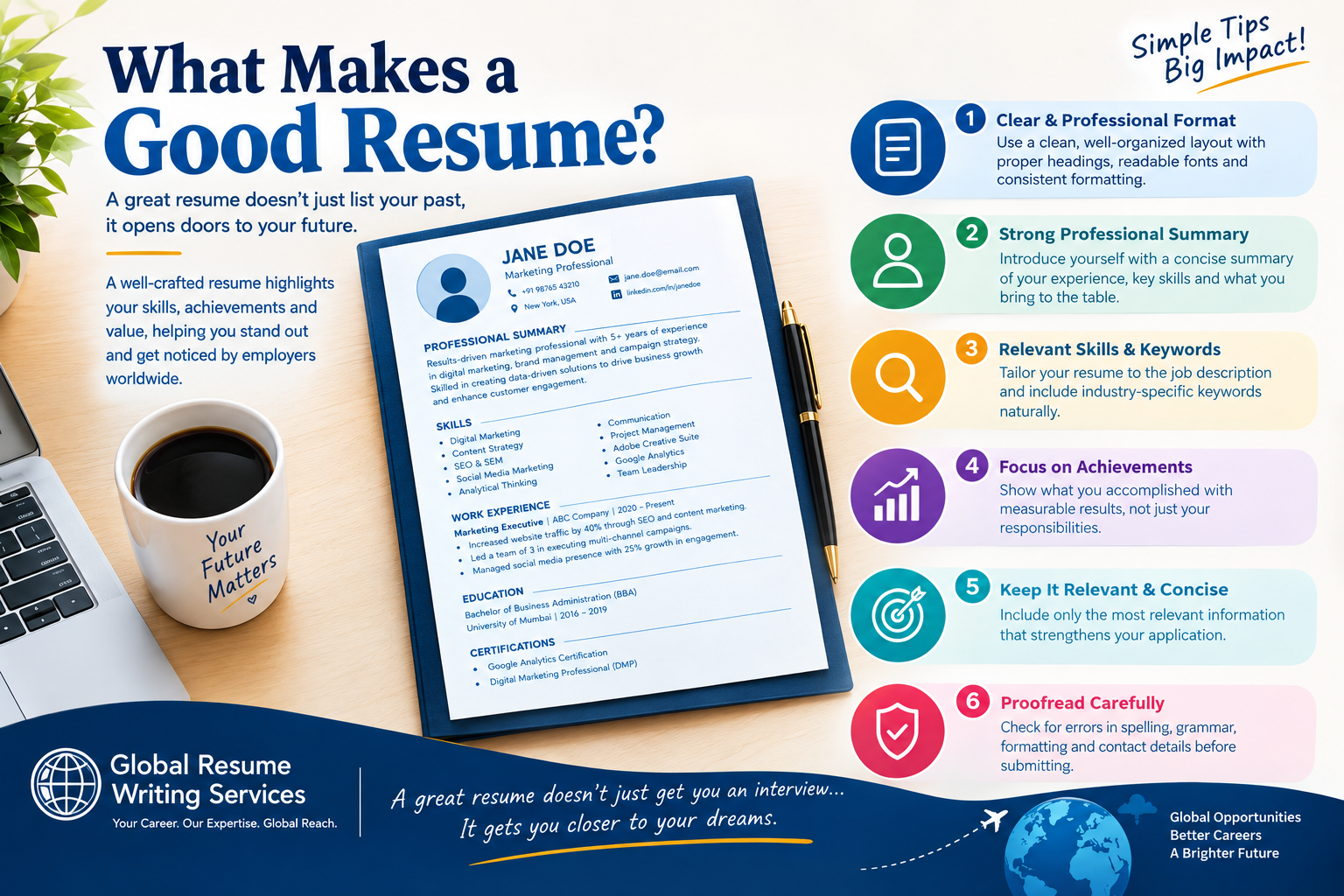
What Makes a Good Resume?
In today’s competitive job market, employers may receive hundreds of applications for a single position. A clear, relevant, and well-structured resume can help your profile receive the attention it deserves.
1. Clear and Professional Format
A good resume should be easy to read and professionally organized. Use clear section headings such as Professional Summary, Work Experience, Education, Skills, and Certifications. Consistent formatting, readable fonts, appropriate spacing, and logical organization make it easier for recruiters to find important information quickly.
Avoid excessive graphics, complicated layouts, and unnecessary design elements, particularly when applying through online recruitment systems. Simple formatting can also improve compatibility with Applicant Tracking Systems (ATS).
2. Strong Professional Summary
Your professional summary should provide a concise introduction to your professional profile. It should highlight your experience, key skills, areas of expertise, and the type of value you can bring to an employer.
Instead of using generic statements such as “hardworking professional,” focus on specific strengths and relevant experience that connect with your target position.
3. Relevant Skills and Keywords
A good resume is tailored to the position you are applying for. Carefully review the job description and identify important skills, qualifications, job titles, and industry-specific keywords.
Naturally incorporating relevant keywords can help an ATS identify the connection between your qualifications and the employer’s requirements. However, keywords should be used naturally rather than repeated excessively.
4. Focus on Achievements, Not Just Responsibilities
One of the biggest differences between an ordinary resume and a strong resume is the way professional achievements are presented.
Instead of simply writing what you were responsible for, explain what you accomplished. Whenever possible, include measurable results such as revenue generated, costs reduced, productivity improved, projects completed, customers acquired, or processes improved.
For example:
Weak: Responsible for managing a sales team.
Stronger: Led a 12-member sales team and increased quarterly revenue by 25%.
Specific achievements provide employers with clearer evidence of your capabilities.
5. Keep It Relevant and Concise
A good resume does not need to contain every detail of your career. It should prioritize information that is relevant to the position you are targeting. Remove outdated, repetitive, or unrelated information when it does not strengthen your application.
6. Proofread Carefully
Spelling, grammar, formatting, and contact-information errors can make an otherwise strong resume look unprofessional. Always proofread your resume carefully before submitting it.
Final Thoughts
A good resume is clear, relevant, achievement-focused, professionally formatted, and tailored to the target position. It should work for both technology and human readers while presenting your professional story with clarity and confidence.
Your resume is often your first opportunity to communicate your professional value. Make every section count, and make every achievement meaningful.
Dr. Avinash,
International Certified Resume Writer
PhD, PhD (HRM), MBA (HRM), MBA (Finance), MSc (Statistics) PGDHRM, DHRM, PHR, SPHR, DIM, PGDIM, PGDIBO
Cell: 096658 80758