
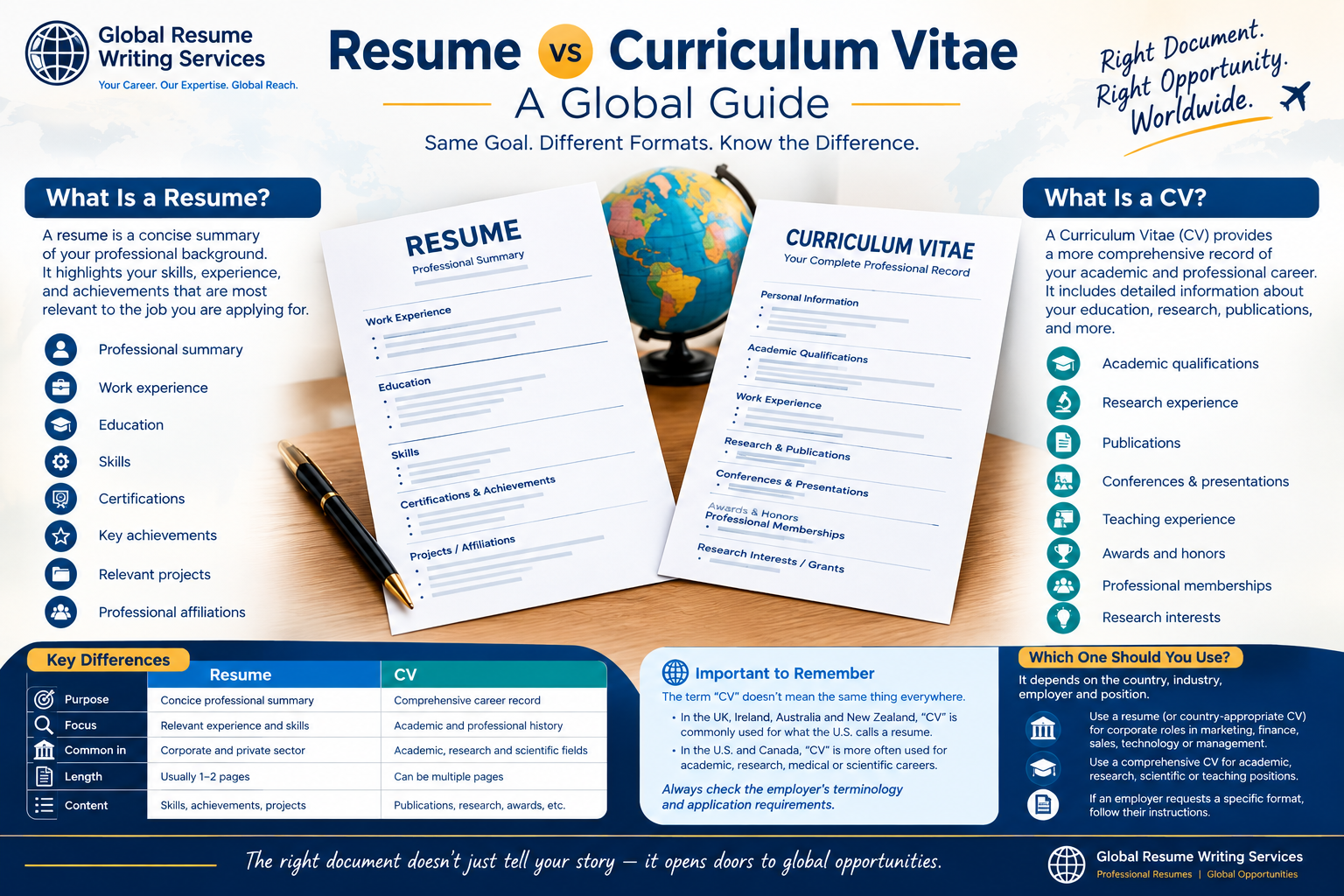
Resume vs Curriculum Vitae: A Global Guide
When applying for jobs internationally, one of the most common questions candidates encounter is: Should I submit a resume or a Curriculum Vitae (CV)? Although the terms are sometimes used interchangeably, a resume and a CV can have different meanings depending on the country, industry, and type of position.
Understanding the difference can help you present your qualifications in the format employers expect.
What Is a Resume?
A resume is a concise summary of your professional background. It typically focuses on the experience, skills, qualifications, and achievements that are most relevant to the position you are applying for.
A resume commonly includes:
- Professional summary
- Work experience
- Education
- Skills
- Certifications
- Key achievements
- Relevant projects
- Professional affiliations
For most corporate and private-sector positions, resumes are usually relatively concise. The exact length depends on your experience and the requirements of the role.
The most effective resumes are also tailored to individual job opportunities, highlighting keywords and qualifications relevant to the specific position.
What Is a Curriculum Vitae?
A Curriculum Vitae, commonly called a CV, generally provides a more comprehensive record of a person’s academic and professional career.
A CV may include:
- Academic qualifications
- Research experience
- Publications
- Conferences and presentations
- Teaching experience
- Awards and honors
- Professional memberships
- Research interests
- Grants and fellowships
- Employment history
CVs are particularly common for academic, research, scientific, medical, and teaching positions, although terminology varies between countries.
Resume vs CV: What’s the Difference?
The biggest difference is usually purpose and level of detail.
| Resume | Curriculum Vitae |
|---|---|
| Concise professional summary | Comprehensive career record |
| Focuses on relevant experience | May include extensive academic/professional history |
| Common in corporate recruitment | Common in academic and research settings |
| Usually tailored to a specific position | Often maintained as a broader career document |
| Highlights skills and achievements | Can include publications, research and academic work |
However, there is an important international consideration: the word “CV” does not mean exactly the same thing everywhere.
In countries such as the United Kingdom, Ireland, Australia, and New Zealand, employers commonly use the term CV for what American employers often call a resume. In the United States and Canada, the term “CV” is more commonly associated with academic, medical, research, or scientific careers.
Therefore, candidates should always check the terminology and application requirements used by the employer and country.
Which One Should You Use?
The right document depends on the country, industry, employer, and position.
For a corporate marketing, finance, sales, technology, or management position, a targeted resume or country-appropriate CV may be expected.
For university faculty, researchers, scientists, or academic professionals, a comprehensive CV may be more appropriate.
If an employer specifically requests a particular format, follow the employer’s instructions rather than relying solely on general rules.
Conclusion
A resume and Curriculum Vitae both communicate your professional qualifications, but their structure, purpose, and usage can vary significantly across countries and industries.
For international job seekers, the key is not simply choosing between a “resume” and a “CV.” It is about creating a professional document that matches the target country’s conventions, industry expectations, and specific job requirements.
Before applying internationally, research the employer’s expectations and tailor your document accordingly. A well-prepared, internationally appropriate career document can help recruiters understand your experience clearly and move your application toward the next stage of the hiring process.