
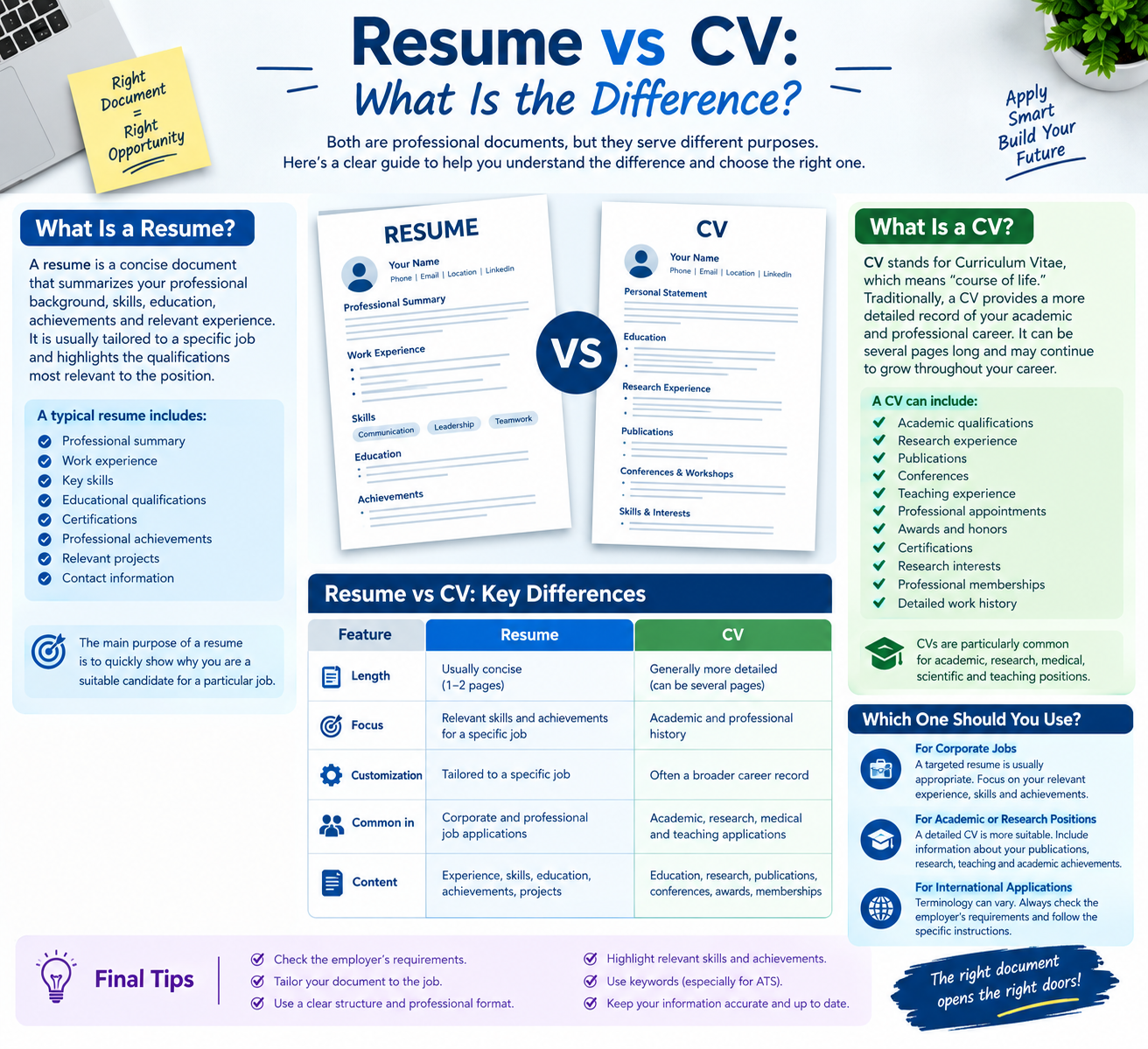
Resume vs CV: What Is the Difference?
When applying for a job, you may come across the terms resume and CV (Curriculum Vitae). Many people use these words interchangeably, but they can refer to different types of professional documents depending on the country, industry, and purpose.
Understanding the difference between a resume and CV can help you choose the right document when applying for jobs, academic positions, internships, or international opportunities.
What Is a Resume?
A resume is a concise document that summarizes your professional background, skills, education, achievements, and relevant experience. It is usually tailored to a specific job and highlights the qualifications that are most relevant to the position.
A typical resume is generally one to two pages, although experienced professionals may have longer resumes when necessary.
A resume commonly includes:
- Professional summary
- Work experience
- Key skills
- Educational qualifications
- Certifications
- Professional achievements
- Relevant projects
- Contact information
The main purpose of a resume is to quickly demonstrate why you are a suitable candidate for a particular job.
For example, if you are applying for a marketing manager position, your resume should emphasize marketing experience, campaign results, leadership skills, digital marketing knowledge, and relevant achievements.
What Is a CV?
CV stands for Curriculum Vitae, which means “course of life.” Traditionally, a CV provides a more detailed record of your academic and professional career.
A CV can include:
- Academic qualifications
- Research experience
- Publications
- Conferences
- Teaching experience
- Professional appointments
- Awards and honors
- Certifications
- Research interests
- Professional memberships
- Detailed work history
Unlike a targeted resume, a traditional academic CV can be several pages long and may continue to grow throughout a person’s career.
CVs are particularly common for academic, research, medical, scientific, and teaching positions.
Resume vs CV: Key Differences
| Resume | CV |
|---|---|
| Usually concise | Generally more detailed |
| Often tailored to a specific job | Often provides a broader career record |
| Commonly 1–2 pages | Can be several pages |
| Focuses on relevant skills and achievements | Focuses heavily on academic and professional history |
| Common in corporate recruitment | Common in academic and research applications |
However, the terminology is not universal. In some countries, including India and the UK, employers may use the terms resume and CV interchangeably. Therefore, it is important to check the employer’s application requirements before submitting your document.
Which One Should You Use?
The answer depends on the job, industry, country, and employer.
For most corporate and professional job applications, a targeted resume is often appropriate. It should focus on your relevant experience, measurable achievements, skills, and qualifications.
For academic or research-oriented applications, a detailed CV may be more suitable because employers or institutions may want information about publications, research, teaching, conferences, and academic achievements.
For international job applications, terminology can vary significantly. Always follow the requirements mentioned in the job advertisement or application portal.
Why Customization Matters
Whether you are preparing a resume or CV, sending the same document to every employer may not be the most effective approach.
A strong professional document should be tailored to the position. Carefully review the job description and highlight relevant qualifications, skills, experience, and achievements.
You should also use a clear structure, professional formatting, accurate information, and appropriate keywords. Many organizations use Applicant Tracking Systems (ATS) to help screen applications, so relevant job-specific terminology can also be important.
Conclusion
The main difference between a resume and CV is their purpose, length, and level of detail. A resume is generally a concise, targeted summary of your professional qualifications, while a CV traditionally provides a more comprehensive record of your academic and professional career.
Before applying for a position, check whether the employer specifically requests a resume or CV and consider the expectations of the country and industry. Most importantly, make sure your document clearly communicates your relevant skills, experience, and achievements.
A well-structured and customized professional document can help recruiters understand your background quickly and make your application more relevant to the opportunity.
Dr. Avinash,
PhD, PhD (HRM), MBA (HRM), MBA (Finance), MSc (Statistics) PGDHRM, DHRM, DIM, PGDIM, PGDIBO
CEO, Global Resume Writing Center
International Certified Resume Writer
Cell: 096658 80758, https://globalresumewritingservices.com/